Archive | Puerto Rican delicacies RSS feed for this section

Chicharritas de Plátano

15 Aug

While I was in Miami, I got the opportunity to make a true Latin specialty – Chicharritas de Plátano.  This is the way I call them when I am in Miami, because in Puerto Rico these are called Platanutres.  They’re exactly the same, people just call them differently, the same way some people say elevator and others say lift… you get my drift.

But not only these are called differently by Cubans and Puerto Ricans, they’re eaten somewhat differently too.  Puerto Ricans eat platanutres mainly as a snack or maybe even as a side to sandwiches.  However, Cubans eat these little fried slices of plantain as an appetizer, a snack or sometimes even as a crispy side dish to accompany rice and black beans.  Also, they like to serve these with a drizzle of mojito criollo, just like the one I showed you to eat with your boiled yucca, without the onions – just olive oil, garlic , salt and lemon juice.  This is my favorite appetizer in any Cuban restaurant in Miami… and Cuban restaurants in Puerto Rico do not have them.  It’s a Miami thing and I LOOOOOOOOVE it!!

You can get chicharritas bagged, just like potato chips.  I have even talked to you about them in our posts on Junk Food, but the freshly made ones are special.   My aunt Gladys, being the “alcahueta” she is, made me some chicharritas before us leaving Miami.  I wanted to go to a restaurant, but she insisted and I took pictures. 


CHICHARRITAS DE PLÁTANO

2 green plantains
Kosher salt
Canola oil to fry them in


  1. Start by peeling the plantain.  Remember to peel them carefully using an oiled knife to avoid staining your knife.
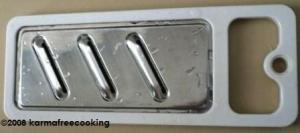
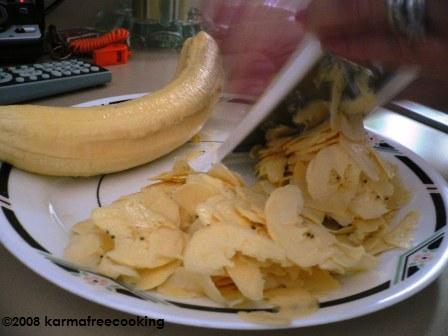
  2. Slice the plantain very thinly using a slicer or a mandoline.  My aunt uses this nifty slicer.  You can slice it in small rounds, which is the traditional way and the way we did them this time around.  In restaurants you usually see the chips sliced the long side of the plantain.  The choice is yours.
  3. Separate and salt the plantain slices.  I always thought the salt was added after frying, but in fact, I like the taste when they’re salted beforehand.
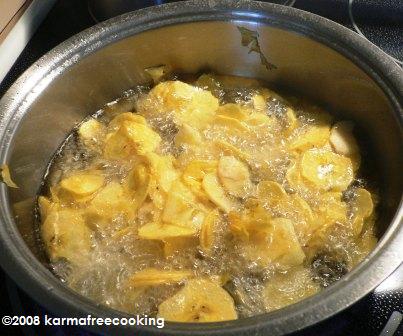
  4. Bring about an inch of oil to frying temperature in a medium sized pot – about 350° F.  To tell you the truth, I never take the oil’s temperature.  Use the wooden spoon method if you want to be sure.
  5. Drop the plantain slices in small batches and try to separate them as much as possible.  Slices will want to stick together. So try to keep the separate.  Fry them until they’re golden.  Keep an eye on them because they go from perfect to burn easily.
  6. Take them out with a slotted spoon and drain in a paper towel.


Enjoy alone, with mojito criollo or as a side dish – I ate them with black beans and rice and slices of avocado on the side.  I love my aunt’s cooking!!!!!

Plantain Tostones

20 Jul

I had already given you a lesson in making tostones when I shared my Tostón Sandwich with all of you.  This time, I want to show those of you who are not familiar with tostones – the traditional way of making them… well, almost traditional because like most of you outside the Latin communities, I do not own a “tostonera” – the implement used to mash the tostones into its traditional shape.  Funny I do not own one, because my dad sells them wholesale.  As they say in Spanish, “en casa del herrero, cuchillo de palo”.

I specify these are Plantain Tostones because tostones can be made from the traditional plantains, or also out of breadfruit.  Tostones (any kind) are a great side dish to many dishes I have shared with you here…   like pastas, rices or even to use as a base for a delicious Antipasto

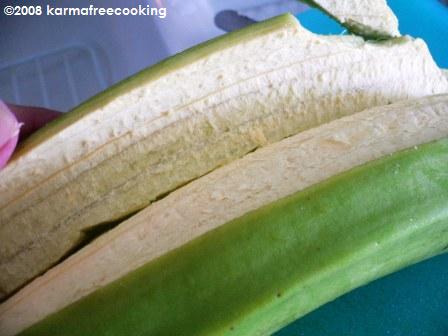
Here’s how… you need to start with Green Plantains.  Optimally, they need to be large, but very green still.   Here is a picture to give you an idea of the differences in ripeness.


PLANTAIN TOSTONES

1 green plantain, peeled and sliced in 1-inch rounds
Canola oil, for frying
Garlic Salt for sprinkling on top after they’re fried
  1. In a small skillet, pour about ½ inch of canola oil over medium-high heat.  Check if the oil is ready by inserting the back end of a wooden spoon.  When bubbles form around the spoon, the oil is ready to fry.
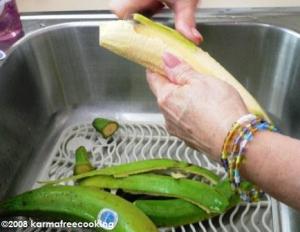
  2. This is how you peel a green plantain… chop off the ends.  Make 3-4 slits from top to bottom ends and with the help of a knife and your finger, take the peel off.  Just like with green bananas, if the plantain is too green, the peel will be difficult to take out and refrigeration will not help.
  3. When the plantain is peeled, cut it into rounds about 1 inch thick.
  4. Place about 3-4 plantain pieces in the oil and start cooking.  Do not be tempted to place all plantain pieces in even if they fit… why? Because you need to cook them partially, smash them and then refry them.  If you fry them too much the first time, they might be hard to smash.  You do not want to over-fry them that first time, so the easiest way is to work in small batches.  If you have someone helping you in the kitchen, you might be able to get adventurous enough to put in a few extra…
  5. Take 2 plates, a salad plate and a dinner plate.  Place a plantain piece on the dinner plate and with the bottom side of the salad plate SMASH the plantain piece down.  Peel the tostón piece off with a spatula (it probably stuck to either the bottom of the top plate) to prevent it from breaking apart and return it to the frying oil.  Repeat with all plantain pieces.
  6.                       
  7. At this point… you can either store them in freezer bags and freeze them until you’re ready to eat them or finish them to eat immediately by frying them for the second and last time. 
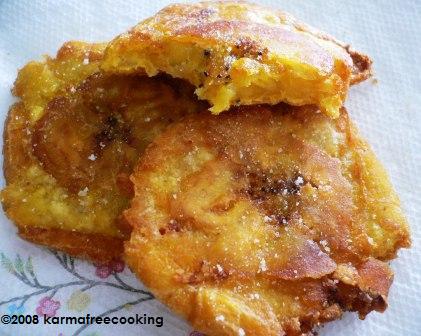
  8. Fry the tostones until they’re golden brown and crispy.
  9. Take them out of the oil onto a plate lined with a paper towel to catch the oil drippings.  Sprinkle with garlic salt as soon as they come out of the oil.


You can also eat them with some butter on top – that’s how my dad likes them…

Macarrones (Soy Crumble Macaroni)

19 Jul

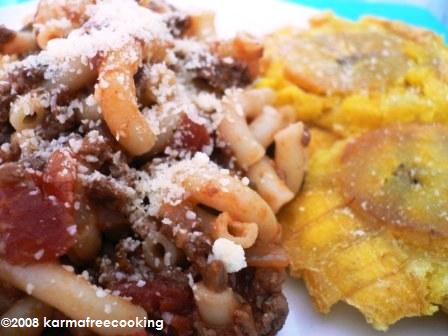
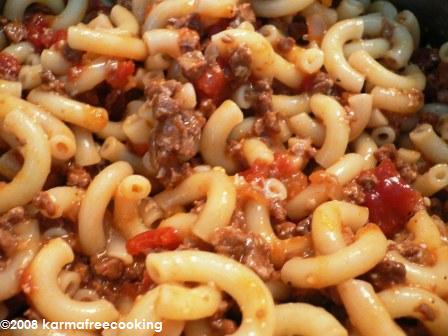
In Puerto Rico, when you mention the word macaroni, people do not think about any cheesy version or salad… people have in mind a mixture of pasta and meat sauce.  I decided to make a version using some Soy Picadillo I cooked the day before.

This is easy, super quick and gives you another use for that Soy Picadillo you may have left over in the fridge…


MACARRONES

1/3 of a packet of whole wheat or kamut macaroni
1 cup of Soy Picadillo
Kosher salt – to salt the boiling water
¼ cup Parmesan cheese, grated
  1. In a large pot, bring water to a boil.  Salt liberally with kosher salt and add pasta.  Cook until al dente, for about 8-10 minutes.
  2. While the pasta cooks, heat up the picadillo in a small saucepan if it was refrigerated.
  3. Drain the pasta when it’s ready and return to the pot where it cooked.  Add the picadillo and mix together well.  Sprinkle the Parmesan cheese and toss again to fully combine.
  4. Serve immediately with additional Parmesan if you’d like.

Soy Picadillo

18 Jul

When I decided to become a vegetarian, I personally made a conscious decision that I did not want to start to eat things that resembled the meat products I was used to eating before.  For some reason, I thought that would not help me modify the way I thought about a plate of food.

People always think of a plate of foods in the terms of – animal protein, starchy and vegetable side dishes, as opposed to looking at a rice dish or a veggie gratin as their main course accompanied by a salad.  That’s why many meat-eaters always ask us the tired question… “You’re a vegetarian??? Then, what do you eat???”

Because of this I consciously decided to keep soy products at a minimum when I first made the decision to become vegetarian.  But soy products are good and have a very useful role within vegetarian cooking.  One of them is textured soy crumbles.  One of my pet peeves is when people call it “soy meat” or “carne de soya”, arrrrgh!!!!  The correct name is textured soy protein or, in Spanish, “protein de soya”.  It’s not meat, so why even mention it in the name??

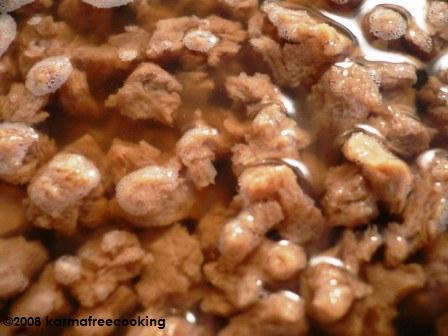
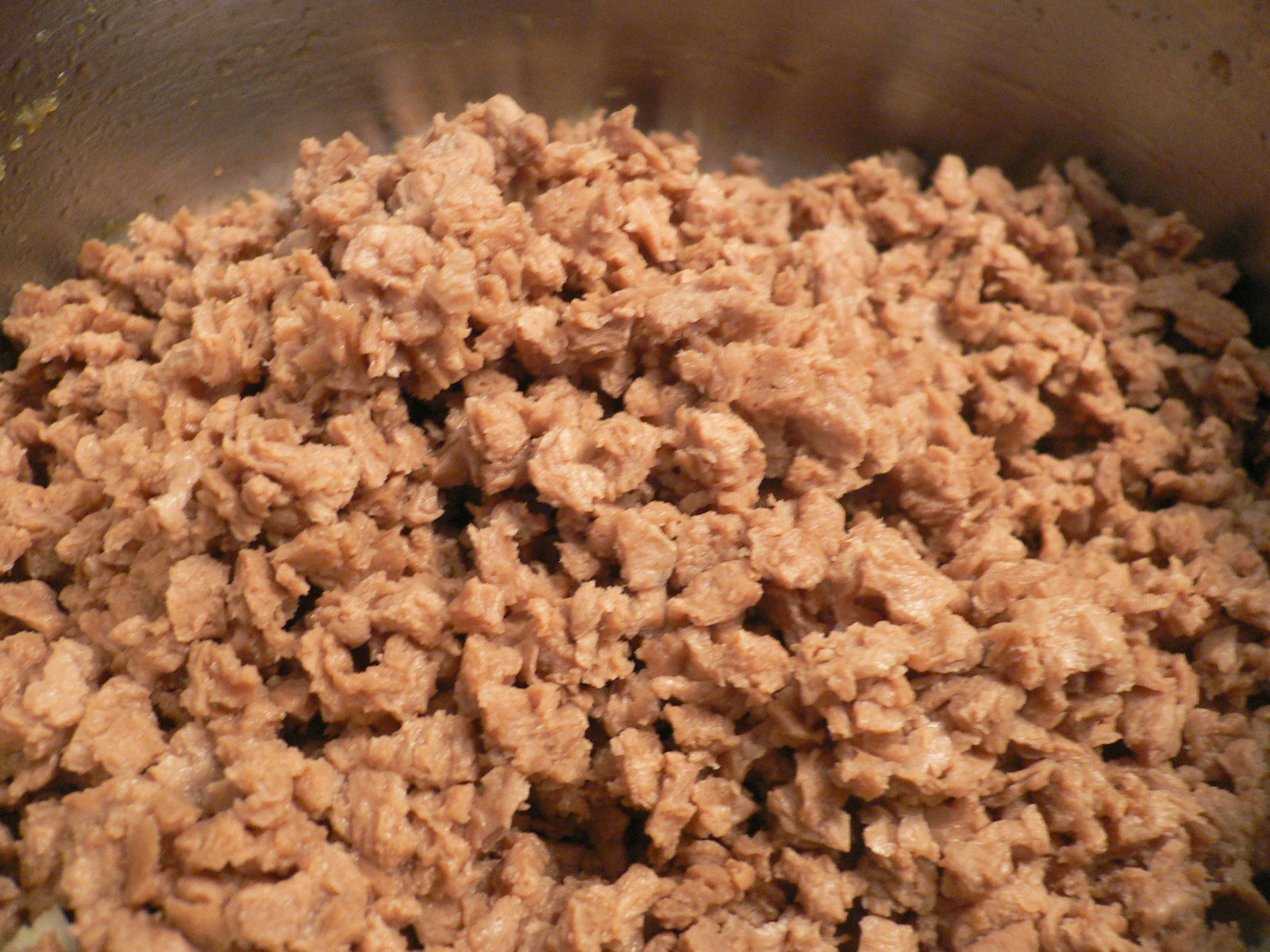
Textured soy protein is sold in bulk at most health food stores and it resembles cereal – a bit like Grapenuts, I think.  It comes in a variety from light to dark and from medium to even little cubes.  I particularly like the medium ground, the lighter the better.  Here’s a picture of the one I refer to, but a bit darker in color than what I usually prefer, but it still works for our purposes.

When cooked, textured soy protein takes on the characteristics of ground meat.  And just like any meat product, the key is in the seasonings.  If not seasoned well, that’s when vegetarian cooking starts getting a bad rep.  But seasoned well, it can even fool the biggest meat-eater out there…. Believe me, I’ve seen it happen.

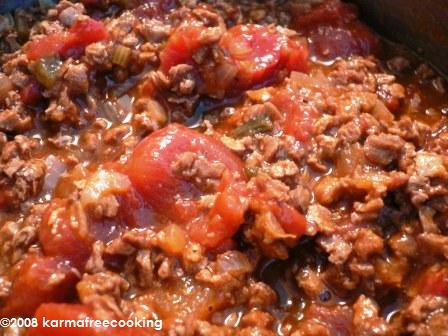
Picadillo is the Cuban/Latin terminology for ground meat in a tomato sauce.  It’s super versatile – to eat on top of rice, to use in a lasagna, to use as the filling for alcapurrias or pasteles, to use inside a pastelón… you name it!!!  So here I’ll show you my version of Soy Picadillo… a great basic to have in your vegetarian arsenal…

SOY PICADILLO – Revised on 01/31/2013

2 tbs olive oil
2 tbs sofrito
½ of a vegetable bouillon cube with sea salt
1 medium onion, chopped
1 cup textured soy protein
1 15oz jar of stewed tomatoes
1/2 cup water
2 tbs tomato paste
¼ cup ketchup
2 bay leaves
1 tsp vegan Worcestershire powder sauce
1 tsp Herbamare seasoning
¼ cup green olives (optional)
2 roasted sweet bell peppers (optional)
2 tbs of capers (optional)
Kosher salt to taste
 
  1. First, we start by hydrating the soy protein.  Soak the crumbles in a medium-sized bowl and cover with filtered water.  Soak for about 20 minutes, until the crumbles are soft to the touch.
  2. After the 20 minutes are up, drain the soy crumbles using a colander, rinse with new running water and squeeze dry as much as possible, just like you do to frozen spinach when you defrost it.  Set aside.  The soy will smell a lot like cereal at this point… do not get discouraged.  This will all change once we cook it with all our seasonings.
  3. In a medium-sized saucepan over medium-high heat, add olive oil, sofrito, the bouillon cube and the chopped onion.  Sautee for a few minutes until the onion softens a bit.  Add salt to season the onions and a bit of pepper if you fancy.
  4. Add the drained soy crumbles to the pot.  You could possibly add a little stream of olive oil to this to prevent the soy to stick to the bottom and sides of the pan.  Remember, soy does not contain fat.  To this, add the stewed tomatoes, tomato paste, water, ketchup, bay leaves, Worcestershire powder and Herbamare seasoning.  If you’re adding the olives, capers or sweet peppers… this is the time to add them.  Check the sauce level…  you should have a fair amount of liquid that will become a sauce, if you feel the mix is a bit dry, add a bit more water.
  5. Cover and let the mixture come to a boil, then lower the heat to medium-low and let simmer for about 40-45 minutes.   You can just turn the heat off, and let it continue to cook with the residual heat for about 15 minutes more… besides, it’ll be too hot to handle immediately.

It’s ready… now you can use this Soy Picadillo in your favorite application.  I used it first as the filling for lasagna.

oooooooooooooooooooooooooooooooooooooooooooooooooooooooooooooooooooooooooooooooooooooooooooo

Ok…. I know some of you might be thinking… IS SHE NUTS?!?!?!  Worcestershire sauce traditionally has anchovies!!! How can she tell us to use it on a vegetarian dish!!!  Well, this Worcestershire powder from McCormick’s is a new discovery for me.  All the ingredients and seasonings of the traditional L&P sauce I used to buy before SANS the anchovies.  Now, be careful with the pepper, because this has pepper and you can over-pepper your dish.     Ever since I published this recipe originally it was brought to my attention that the “natural flavor” on the ingredient list might possibly be anchovies.  So I do not recommend using this product anymore.  I do use vegan Worcestershire Sauce available at health foods across the country.  Make sure you buy vegan to make sure there are indeed no anchovies in the product.

Sweet Plantain and Spinach Pastelón

17 Jul

This is one of my favorite pastelones ever!!!  It’s sweet and savory all at the same time.

I learned that my grandma has a plantain tree in her backyard.  I am super happy because now we have all these awesome and delicious plantains, at a time when plantains are close to $1 each.  Ludicrous!!!

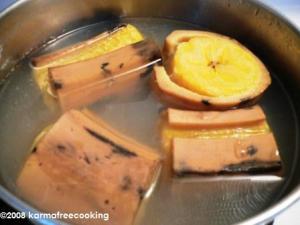
This pastelón is made with very ripe plantains… if you take a look at this picture, the plantain need to be like the one in the bottom or even with more spots than that.  This will ensure the plantain is ripe indeed.  The one on the middle is not fully ripe, even when it looks pretty and yellow.


SWEET PLANTAIN AND SPINACH PASTELON

1 sweet ripe plantain
1 cup frozen spinach
4 oz of cream cheese, at room temperature preferably
½ cup Parmesan Cheese, divided
1 tbs butter
Dash of milk, optional
Salt and freshly cracked black pepper
  1. First off, we need to boil the plantain.  So we cut off the ends, make a slit from one end to the other of the plantain and then cut into 4 pieces.  Do not remove the skin.  Drop them into a pot with salted water and let it boil covered for about 20 minutes.
  2. In the meantime, defrost the spinach and squeeze out as much water as possible.  Mix in with the cream cheese and season with salt and pepper.
  3. When the plantain is cooked, drain and remove skin, placing the skinless pieces of cooked plantains in a bowl.  Mash the plantains with the butter and ½ of the parmesan cheese.  Add the milk to the plantain mash now, if using.

  1. Pre-heat oven to 350° F.
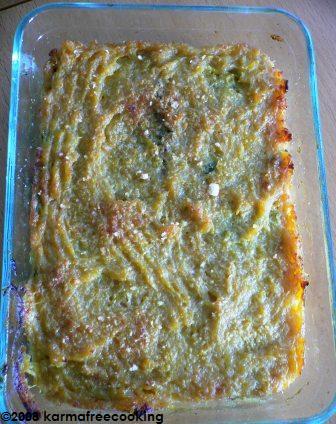
  2. In a glass baking dish sprayed with canola oil, spread ½ the plantain mixture in the bottom.  Layer the spinach/cream cheese mixture and finish off with the remainder of the plantain mash.  Top the pastelón with the rest of the parmesan cheese to form a nice crust.
  3. Bake in the oven for about 20-30 minutes, until the cheese on top creates a crust and the flavors meld together.
  4. Leave in the oven for 15 minutes more to allow setting.