Archive | Puerto Rican delicacies RSS feed for this section

Coconut Tembleque

26 Apr

Tembleque is a Puerto Rican dessert, traditionally made mainly during Xmas time.   However, it can be enjoyed year round.  And it’s a special treat when you can taste it outside of Xmas… very unexpected.

The name “tembleque” comes from the verb “temblar” or “to tremble”.  The dessert is a jiggly/trembly custard made with coconut milk, sugar and set with cornstarch.  I added the word coconut in the name for the benefit of those who are unfamiliar to the tembleque dessert.  But, we do not add the word coconut in front; it would be “redundant”, because tembleques are only made with coconut milk… there are no other versions… yet. (This explanation is giving me ideas…)

We decided to make this because so many people in the Center who are avoiding wheat, spelt and dairy products so dessert options need to get more creative each time.  Plus, this would be a good accompaniment to other true Puerto Rican delicacies such as Arroz con Gandules and Alcapurrias.

It’s easy and super delicious…  check it out.


COCONUT TEMBLEQUE

Makes about 24 servings


12 cups of coconut milk
1 ½ cups of brown sugar
6 cinnamon sticks
1 ¼ cup cornstarch, diluted in some reserved coconut milk and ½ cup water
Ground cinnamon, to garnish


  1. In a large pot, pour about 10 cups of coconut milk, sugar, cinnamon sticks and bring to a simmer.
  2. In a small mixing bowl, mix together the remaining coconut milk, the cornstarch and water.  Whisk together well and pour into the simmering coconut milk. 
  3. Whisk in the whole coconut milk mixture until it thickens slightly.
  4. While it still hot, CAREFULLY (because it can burn you – I speak from experience), divide in individual servings, about  1/3 – ½ cup each.  
  5. Garnish with a sprinkle with ground cinnamon on top.
  6. Refrigerate for about 2-3 hours.  Serve cold.

Aniette’s Bull

3 Apr

 Aniette has been my friend for many years now… since high school, now that I think about it.  We might not be in contact very frequently, but when we get together is like time has not passed by.  We have been with each other thru many good and not so good times and I am very grateful and fortunate to call her my friend…  Aniette is the original creator of the Sweet Red Pepper Dip – she was the one who showed me how to make it after a long guessing session trying to decipher what was the dip made off.  Aniette is also fluent in French… ever since high school she was reading full novels in French.  I invited her to our little French-speaking soiree, but she was planning a romantic weekend with her husband, so I could not really coax her into coming to my house to just speak French… no contest there.

But even though she was not here in person, she was with us in spirit… because the signature drink I served up at our French get-together was also inspired by Aniette – I had a version of this “bull” at a get-together we had at Chez Aniette a few months back.  I almost drank the whole pitcher by myself…  I was blown away by how delicious it tasted.

Why call it a “bull”??  I don’t know… Don’t shoot the messenger here, but in Puerto Rico we call a punch, like the kind served at the high school parties you see in the movies, a “bull”, pronounced “bul” – short U and short L.  And a punch bowl is called a “bulera”.  Hey… I don’t make this stuff up.  Besides, this will be a fun anecdote to tell around the “bulera” the next time you’re invited to a party, no??

This is an adaptation of Aniette’s original recipe, because I could not find all the ingredients I wanted for the original version… but the alternate was a hit as well, and so, I still give Aniette full credit.

p1030223.jpg

ANIETTE’S BULL

1 can frozen passion fruit juice concentrate
16oz of guava juice
8oz of grape juice
8 oz of orange juice
1 bottle of Martinelli’s Sparkling Cider – non-alcoholic
  1. Allow the frozen concentrate to thaw out a bit in the fridge.
  2. Mix all the ingredients in a pitcher.
  3. Serve chilled over ice.

Tostón Sandwich

19 Mar

I am sooooo proud of Iván Avilés…  he was the winner in the Comfort Foods episode of Ultimate Recipe Showdown, a new Food Network cooking competition where regular cooks, just like you and me, compete to see who has the Ultimate recipe in a series of categories.

And why I could be proud of Iván specifically??  He’s Boricua (another word for Puerto Rican, derived from Borinquen, the original indigenous name of Puerto Rico) and he won with his Boricua Plantain Sandwich.  It’s not vegetarian, but it did remind me of a sandwich my friend Tania taught me how to make a few years back.  I was so surprised to see Iván use TOSTONES as the “bread” for the sandwich, something I had only seen Tania do.

Tostones (which are also called patacones in South America) are twice fried mashed green plantains.  Tostones are a staple in Puerto Rican cooking and for people trying to “get away from the carbs” are a great bread substitution in this sandwich.  But less carbs does not mean less fat – I did tell you these are TWICE FRIED, no?

Let me give you the play by play to making my vegetarian version of the Tostón Sandwich…


 sand-toston-copy.jpg


 TOSTON SANDWICH

1 green plantain, peeled
2 small strips of firm tofu – you can definitely used extra firm here, but never the silken kind
1/4 onion, sliced
Garlic Salt
1/4 cup Tamari Sauce
Ketchup
Canola Oil for frying


  1. Take the tofu pieces and press them in between 2-3 good paper towels or napkins (I use Bounty) to drain away most of the liquid.  I place then in between 2 small baking sheets and weigh using something heavy.  I change the paper towel at least once.  meanwhile…
  2. Peel the green plantain.  Remember that green plantains, just like green bananas, have a sap (mancha).  Remember to oil the knife you’re using to peel the plantain so the sap does not adhere to the knife.  Follow the method I showed you for the green bananas here.
  3. In a medium skillet, heat about 1 cup of canola oil over medium high heat.   Just make sure the skillet is wide enough that will fit your plantain.  If your plantain is on the small side, by all means, use a smaller skillet.  You need enough oil to cover the plantains halfway, more or less. 
  4. Cut the plantain in half lengthwise, making two long halves.
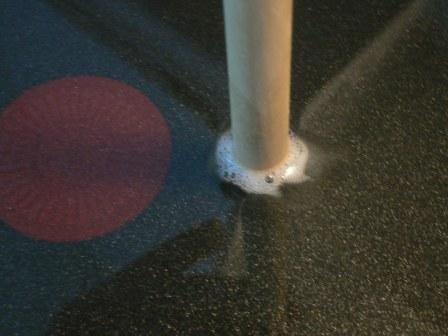
  5. Make sure the oil is hot enough.  Rachael Ray taught me to dip the end of a wooden spoon into the oil.  If the oil bubbles around the spoon, the oil is ready.  I love this tip.
  6. Fry the plantain halves for about 5 minutes.  What you’re looking for is to cook the plantain, add some color to it, but without getting it crispy.
  7. Take the partially fried plantain halves out of the oil and using either two heavy plates or two small baking sheets, smash them flat.   If using baking sheet, place a kitchen towel on top so the heat does not transfer to your hand.  Keep the oil in the hot stove, you will use it again.  Sorry I don’t have a picture of this, but I was by myself making this and I could not smash and photograph at the same time.  This is the already-smashed plantain…
  8. After smashing the plantains, re-immerse the smashed plantain halves in the hot oil to finish frying. 
  9.  

    12.jpg

  10. This time, the end result should be a golden and crispy plantain halve – this is a Toston.  Tostones typically are made the exact same way with the exception that instead of being cut lengthwise, you cut the plantain in 1 inch round slices.
  11. Drain the finished tostones on a paper towel and sprinkle some garlic salt to season them.  Keep the aside while you make the fillings.  They need to cool off a bit if you don’t want to burn the roof of your mouth.
  12. Drain the skillet of the hot oil CAREFULLY and in that same hot skillet with some of the remaining oil on it,  place the drained tofu pieces and the onion slices.  The object of this is to smother the onions and to cook the tofu and for it to dry out a bit.  Add some garlic salt to the onions to season them.
  13. When tofu slices have gained some yellowy color (they will not change color very dramatically), dunk them in the tamari sauce for a few minutes.  Return them to the skillet to finish “frying”.
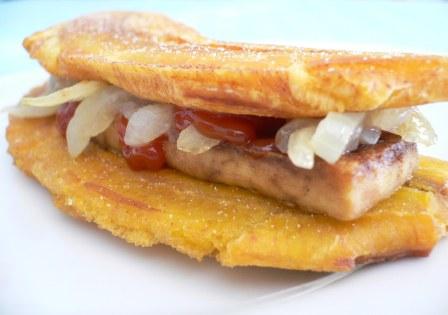
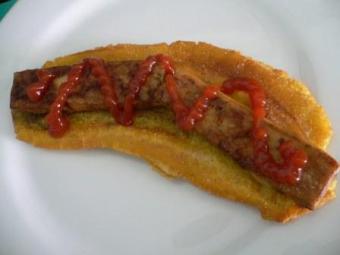
  14. Now we assemble – Place the wider tostón half on a plate, place tofu pieces, squirt some ketchup, place smothered onions, squirt some extra ketchup and top with the remaining tostón half. 
11.jpg


Mmmmmm!!!!!


 10.jpg


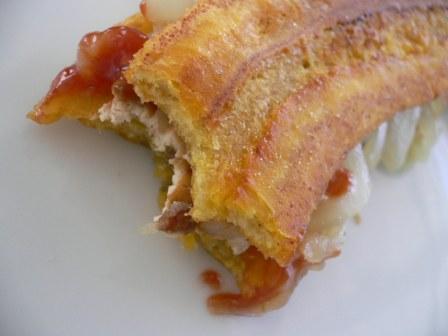
I have also made this with fried white cheese instead of the tamari-marinated tofu.  It tastes delicious!!!  If you fry the tostones in hot enough oil and drain them, they will be crunchy, but not oily.

I had not done this sandwich in a long time… so I thank Iván and the Ultimate Recipe Showdown for reminding me.   And even it’s not vegetarian, you can taste an adaptation of Iván’s sandwich at your local TGIFriday’s restaurant.  They’re made with sweet ripe plantains, which is a different “ball game”, but still you can come out and support my fellow Boricua!!!


Green Banana Mash

21 Feb

In Puerto Rico, when one does not feel well, we usually immediately crave or get prescribed “viandas” – viandas are mostly tubers – potatoes, yuca, yautia, malangas, sweet potatoes, yams, and for some reason plantains and green bananas are jammed up in there.  They are easy on the digestive system and seem to help you “get on your feet” again.

For some weird reason, I was craving viandas yesterday.  I went to the supermarket and spent 19 cents on 3 green bananas.  there is still something cheap at the supermarket.  Yes, bananas can be eaten ripe and green too… but you need to cook them.  We usually boil them.  But I need to show you a trick for it.

 guineos-verdes-y-aceite.jpg

Green bananas, just like green plantains, have what we call “mancha” – they release a sap when you cut them open.  To avoid this, you just wipe some cooking oil in your hands and on the knife you’ll use to prevent the sap to stick to any of them.  When you go and boil them, add some cooking oil to the boiling water to prevent the sap to get on the saucepan.

Be careful – this mancha or sap STAINS A LOT.  If you get it on your clothes, more than likely you will not be able to get it off.  There’s a local saying when you can’t deny being a Puerto Rican, people say that you have “la mancha de plátano” or “plantain sap stain” resembling the fact that the sap from a green plantain or banana can’t never be cleaned or taken away. 

Here’s what you do…

 guineo-verde-mash.jpg

GREEN BANANA MASH

3 green bananas
Salt – for the boiling water
Cooking oil – for the boiling water, your hands and the knife
Extra-virgin olive oil
Garlic Salt to taste 
  1. In a large pot, fill with water.  Add salt and a squirt of cooking oil. 
  2. Cut off the ends of each banana and cut a slit all the way down the banana.  Do not take the skin off the banana.  We’ll boil them with the skins on.  
  3. Boil in the pot for about 20 minutes, until the bananas are fork tender.  the water will turn a weird color – don’t dispair.  This is the sap in the banana skin.  
  4. Drain the bananas.  Take the skin off.  It should come off very easily.
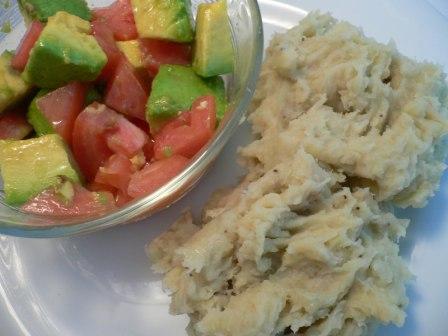
  5. Mash with a fork while still warm… they’ll be harder to mash when they’re cool.  Drizzle with olive oil until you get a smooth consistency and season with garlic salt.

With a few more steps… we can convert this into mangu, a delicious Dominican dish.  That in an upcoming installment – OK?

I had this with my Avocado and Tomato Salad.

Potato and Fried Eggplant Pastelon

16 Feb

I’ve been trying to “crack my head open” trying to figure out a way to translate the word “pastelón” for you guys.  A pastelón is very similar to a casserole… but the difference being that things are mainly layered in instead of mixed all -together.   So I figured that if Rachael Ray can invent a word in “stewp”, I can just use the word “pastelón” and you’ll learn to embrace it.

Pastelón is pronounced  [pas-te-LON], and as I mentioned before, it consists of layers of ingredients, sometimes pre-cooked, sometimes raw and then baked off in the oven.

This is a new installment for the Potato Festival I mentioned a few posts ago…  I know, the translation thing should have not kept me for posting this, but I guess I got caught up in it.

pastelon-papa-y-berenjena-1.jpg

POTATO and FRIED EGGPLANT PASTELÓN

3 medium potatoes cut into 2″ pieces – you can use new, russet or red-skinned potatoes
 1 small eggplant – try to buy the lightest eggplant available*
½ cup whole wheat flour
2 tbs sofrito
¼ – ½ cup of water
2 tbs butter
2 tbs cream cheese
4 tbs grated Parmesan cheese, divided
A splash of milk
¼ cup Italian cheese blend
Salt, Garlic Salt and Pepper to taste
Canola oil – to fry the eggplant

*  Note:  The lighter the eggplant, the less seeds it will have and the less bitterness it will have.

  1. In a medium sized saucepan with salted water, boil the potatoes until fork-tender.  I find the potatoes boil faster when I use as little water as possible…  I guess it’s a combination of boiling and steaming… I don’t even let the water cover the potatoes.  Just let the water come up halfway the potatoes.
  2. Then, you need to prepare the eggplant batter…  Mix together the flour, water, sofrito and season generously with salt and pepper.  Use enough water for the batter to have the consistency of pancake batter.  Set aside.
  3. In a skillet over medium-high heat, heat oil for frying.
  4. Slice the eggplant your favorite way – in rounds or in long slices.  Dunk the eggplant slices in the batter.  Clean up any drips and fry until golden brown. Drain the fried slices over paper towels to soak up any excess oil.  Set aside.
  5. Pre-heat oven to 350 degrees F.
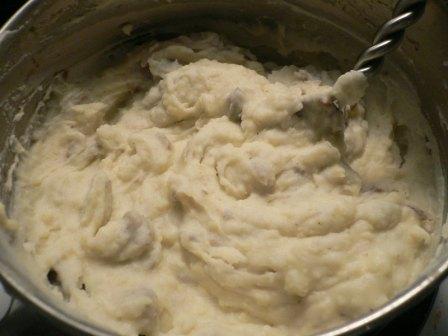
  6. When potatoes are done, drain any liquid leftover.  Mix in butter, cream cheese, 2 tbs of the Parmesan and milk.  Smash then until creamy soft.  Season with garlic salt and pepper.
  7. Pour half the mashed potatoes in a buttered casserole dish.  Add in the fried eggplant slices creating a layer.  Sprinkle a bit of Parmesan cheese (optional).  Add in the remaining mashed potatoes.  Top with the last of the remaining Parmesan and the shredded cheese mix.

pastelon-papa-inside.jpg

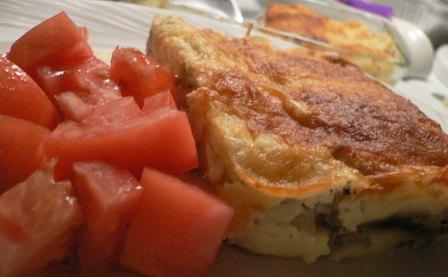
10.  Bake in oven for about 30 minutes, until the cheese on top is melted and golden brown and the flavors meld. 


pastelon-papa-y-berenjena-slice.jpg