Archive | Puerto Rican delicacies RSS feed for this section

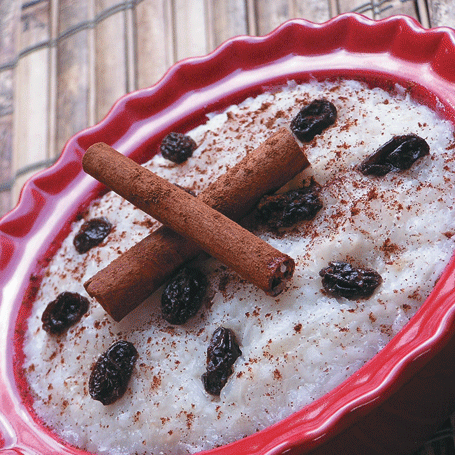
Arroz con Dulce

13 Dec

This recipe is from Cielito Rosado, with whom I had the pleasure to work with when I managed the advertising of a very popular dish washing liquid. She’s one of the few well-known cooks in Puerto Rico… her recipes are simple and easy to follow.

Arroz con Dulce, loosely translated to Sweetened Rice, is a typical Xmas dessert. You really do not see it anywhere before Thanksgiving or after the Fiestas de San Sebastián. The key is to not have it be too sweet or too bland… and brown sugar is key.


ARROZ CON DULCE

1 ½ cups of rice, soaked in water
For the cooking liquid:
1 ½ cups water
20 cloves
2 cinnamon sticks
A piece of fresh ginger
3 cans of coconut milk
1 ½ cups brown sugar
1 cup shredded coconut
2 tbs raisins
2 tbs butter
Ground cinnamon to garnish


  1. Add the cloves, cinnamon sticks and ginger to the water in a medium saucepan. Cook over medium-high heat for about 5-8 minutes. Then, strain and discard the spices. Return the tea to the same saucepan.
  2. Drain the rice that has been soaking in water; add it to the strained tea and coconut milk. Cook over medium heat until the liquids boil. Cover and lower the heat until the liquids reduce and the rice is cooked.
  3. Add the brown sugar, shredded coconut, raisins, butter and cook for an additional 15 minutes.
  4. Pour the cooked rice into a serving platter and garnish with sprinkled ground cinnamon.

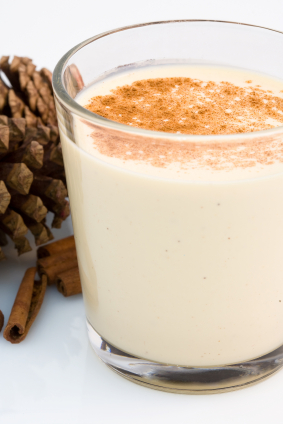
Coquito 2

10 Dec

I am a coquito FANATIC!!! Every year I make a few batches of my non-alcoholic version of Coquito. Xmas would just not be the same without it.

But I have to admit my original recipe has evolved a bit. I wanted it to be a bit sweeter and creamier so I started adding Cream of Coconut to the recipe to maintain the coconut essence without adding sugar directly into the mix.

Cream of Coconut is what we traditionally use to make Piña Coladas and the best brand is Coco López. Even if other brands might be on sale, I prefer to buy Coco López. I do read the labels once in a while to make sure no super weird ingredients have been added to it.

This newer version is still non-alcoholic, something my friends with little kids appreciate, but know it has an even creamier feel to it.  Salud!!

COQUITO 2

3 cups of water
5 cinnamon sticks (I usually use a whole bagful)
4 tbs cloves (I usually use a whole bagful)
4 tbs anise seeds (I usually use a whole bagful)
2 tbs star anise (I usually use ½ bagful)
1 can of sweetened condensed milk
1 can of coconut milk
1 can of cream of coconut
1 can of evaporated milk
2 tbs ground ginger
1 tbs ground cinnamon
2 tbs vanilla extract or vanilla powder
1 tbs freshly ground nutmeg


  1. In a medium saucepan create a “spiced tea” – pour the 3 cups of water, cinnamon sticks, anise seeds, star anise and cloves. Steep for about 15-20 minutes to create a strong spiced tea. This will give the coquito most of its spiciness. Let cool a bit.
  2. In a blender, mix together the evaporated milk, condensed milk, coconut milk and cream of coconut with 2 ”cans-worth” of the spiced tea, ground ginger, nutmeg and the vanilla powder.
  3. Pour into a clean bottle and chill in the refrigerator.
  4. Serve chilled in small shot glasses. Sprinkle with ground cinnamon.

Grapefruit Benefits

13 May

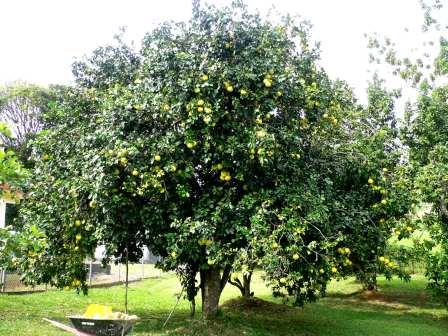
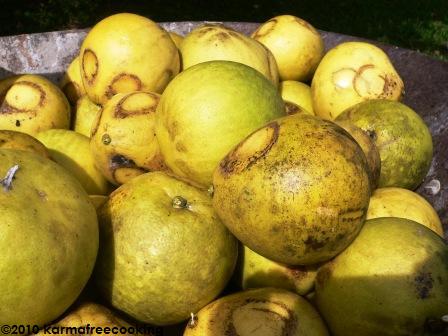
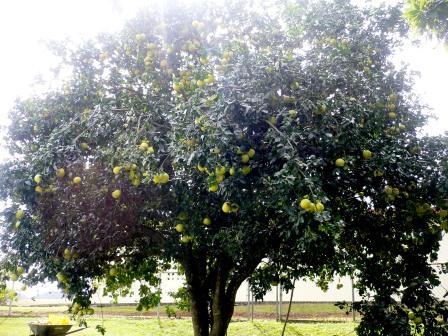
My Tití Carmín has an orchard of beautiful grapefruit trees…  These trees are the most prolific grapefruit trees I have ever seen.  They are giving fruit almost all year-round.  So even though we are currently in citrus season, these trees don’t know what that is.

I have always loved oranges, but not so much grapefruits.  When I was little, I had tried some canned grapefruit juice that was just awful.  But all that changed when I tried the juice from my Tití’s grapefruits.  These grapefruits are juicy and sweet.  And they like to proliferate, because they’re filled with seeds.  Tití would make juice for me and at the beginning she would sweeten it a little, making a “grapefruitade”.  She would squeeze the juice for me and bring it already in a bottle. 

Now, every time we visit Tití Carmín, we return with bagfuls of grapefruits; sometimes enough grapefruits to make about 96 ounces of pure juice.  Now I just drink it straight without any need to sweeten.
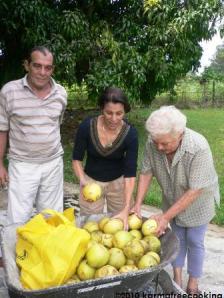
And that got me thinking… about the bountiful of health we have in our hands.  I have once heard that nature gives you everything you need to be healthy at about 20 feet around where you live.  Tití Carmín lives a bit farther away than 20 feet from me, but the access we have to these grapefruits made me want to think what benefits we are getting when I consume this delicious juice…

Here’s some of the research I did:
              

  • Contains high levels of Vitamin C to protect against colds and flu and drinking a freshly-squeezed grapefruit juice helps also relieve sore throats and soothes coughs. The vitamin C also helps to strengthen and maintain the elasticity of arteries and helps to reduce water retention and swelling of the legs during pregnancy.


  • The pectin in this fruit has been found to be effective in reducing the accumulation of arterial deposits keeping arteriosclerosis at bay.


  • It has lots of vitamins and minerals like Vitamin A, B complex, E, K, Calcium, folic acid, phosphorus, and potassium.

  • Nutritive phytonutrients and antioxidants that help fight cancer. Studies show that lycopene-rich foods, like grapefruits reduce the risk of ovarian, cervical, breast, prostate and colon cancer.  And when eating or juicing grapefruit, peel off the skin but leave as much of the albedo (the white pith part) intact as possible as it contains the highest amount of valuable bioflavonoids and other anti-cancer agents.


  • A certain compound found in grapefruit helps reduce the excessive production of cholesterol from the liver. A Harvard study revealed that drinking one glass of grapefruit juice or eating half a grapefruit daily lowered LDL (bad) cholesterol levels by 33 percent. And another study indicated specifically that red grapefruit reduces levels of triglycerides.


  • Grapefruit has a fat-burning enzyme and can help to absorb and reduce the starch and sugar in the body. It is widely consumed by people who are trying to lose weight. A Johns Hopkins study found that people who had two servings of grapefruit or grapefruit juice daily along with a low-fat and low-calorie diet lost an average of 19 pounds over a period of 13 weeks. Cool, huh?


  • Sometimes, when using certain medications doctors recommend avoiding grapefruit juice because supposedly the grapefruit halts the metabolism of these drugs.  Doctors may tell you that grapefruit is the cause of toxicity, but in fact, it is really the drugs that are causing the toxicity.  The abundant source of limonoid and naringin in grapefruit increase the function of detoxifying enzymes in the liver and will reject synthetic man-made drugs. These enzymes help to recognize alien compounds which should not be in our body, treats as toxins and makes them more water soluble to be excreted easily from the body.  


  • I was pleased to learn that grapefruit has many digestive benefits too… just like lemons and limes, even though it has an acid taste, its juice promotes good digestion and actually has an alkaline reaction after digestion by increasing the flow of gastric juices. This has a profound effect in the treatment of acidity in the digestive system that causes a host of other health problems.


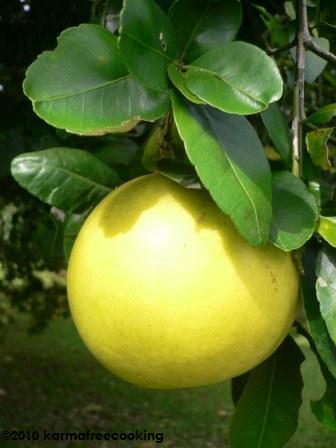
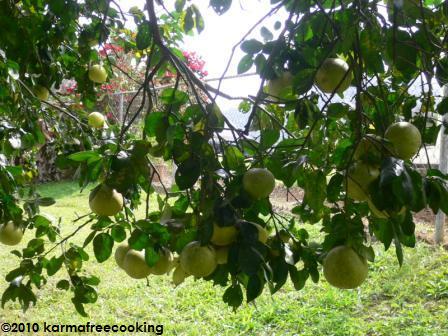
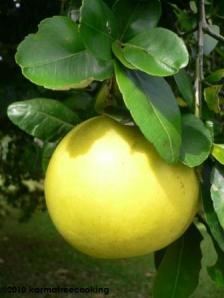
One last curious thing… It is called a grapefruit simply because it grows in clusters, like grapes.  I did not know that as a fact, but check out this photo… the do gow in clumps and that’s why they always have three indentations because they cant be completely round growing next to the other.
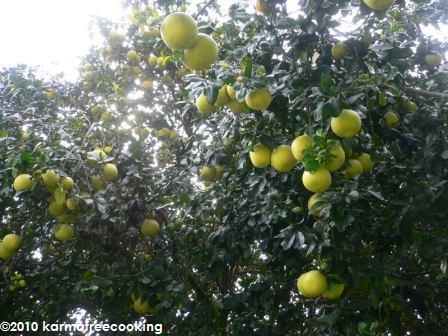


I hope you learned as much as I did of all the benefits this awesome elixir has.  Now you can toast with a big glass of grapefruit juice and confidently say “To your health!!!”


Grapefruit

Pasteles in Banana Leaves

23 Dec

This is a very labor-intensive dish… the very same reason why most people in Puerto Rico buy their “pasteles” from someone who has the experience and the patience to make these.  In our yoga center, Mai, Mili and Katy are the pasteles experts.  They even make them to sell to anyone who’s interested in a delicious vegetarian version.

Pasteles hold the essence of the Puerto Rican holiday dinner…  a Xmas season without pasteles is like a day without sunshine, a beach without sand…  you have not eaten true Puerto Rican holiday food until you have one of these.

The whole deal is this MASA made from green banana and yautía filled with a soy-based stew.   Then it’s all wrapped in a banana leaf that will actually give the masa some of its flavor.  It’s very characteristic and you can find banana leaves in the refrigerated or produce section of a Latin supermarket.   Pasteles without at least a piece of banana leaf miss something.


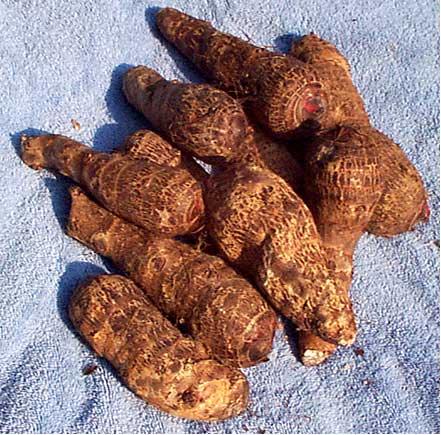
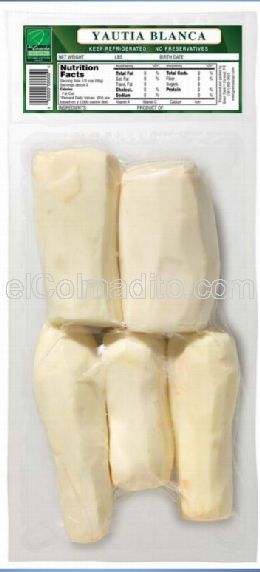
This is a yautía… in Cuba, yautías are called malangas.  However, in Puerto Rico we call malanga a completely different tuber.  Do not confuse them.  I looked up in the internet and apparently it may also be called tanier = tannier = tannia.  Don’t know where, but if you can’t find them by the yautía name, any of other those might also work.  Yautías come in two varieties – white and purple.  You will need yautía blanca or white yautía for this dish.


PASTELES IN BANANA LEAVES

12 green bananas
1lb white yautía
¾ cups milk
1 ½ tsp salt
2tbs sofrito
2 tbs annatto oil
Filling:
½ cup textured soy protein – in cubes, soaked in filtered water for about ½ hour
1 small potato, cubed small
1 cup cooked chickpeas or garbanzo beans
2 cups mixed vegetables
½ cup raisins (optional)
½ cup sliced Spanish stuffed olives
3 tbs sofrito
2 tbs tomato paste
2 cups water
1 tbs olive oil
 
20-25 pieces of paper to roll pastels
Banana leaves – cut into rectangles of 10” x 8” approximately
Cotton kitchen twine


  1. Peel the banana and yautía and shred them using a food processor or a machine called Champion.  I have seen this machine also be used at Iron Chef America competition.
  2. Add the sofrito, salt, annatto oil and milk to the banana and yautía mixture.  Mix it all well to create a homogenous smooth mixture.  The annatto oil will provide a bright yellowy/orangey color to the mixture.  Set aside.

Now we make the filling…

  1. In a large saucepan, cook the olive oil along with salt, sofrito and tomato paste.    Add the garbanzo beans, soy protein, potato and water and cook everything for about 15-20 minutes. 
  2. Add the mixed vegetables and the raisins, if using.  Cook everything for about 15 more minutes.  Once everything is cooked, add the olives.

Now we assemble the pasteles…

  1. Place a banana leaf on top of the pastel paper (it’s similar to butcher’s paper). 
  2. Take a little bit of the sauce of the soy mixture and wet the banana leaf. 
  3. Take a large cooking spoon and spoon about a spoonful of masa in the center of the banana leaf.  Using the spoon, form a well in the center of the mixture and place about 2 tablespoons of the soy/vegetable mixture in the well. Carefully fold the leaf over, in order to cover the filling with masa on all sides. DO NOT over stuff them.
  4. Fold the paper like a letter and fold in the sides to create a compact package.  Tie them with cooking twine.  Be careful not to tie too tightly.
  5. Repeat this procedure until all the masa mixture has been used. You can now freeze or cook them when you are ready.  

When you are… 

  1. Place a large pot of salted water (as if you were to prepare pasta).  Boil the pasteles for about 45 minutes until the masa is cooked.  If you froze them, place them directly from the freezer onto the boiling water and boil for about 1 hour.
  2. Drain them well when you take them out of the water…  it’s not nice to have a puddle of pastel water in your plate when serving yourself the rest of the Xmas dinner.  Many people, including me, enjoy pasteles with a drizzle of ketchup on top.

Rice with Pigeon Peas – Arroz con Gandules

22 Dec

Rice with Pigeon Peas (Arroz con Gandules) is one of the quintessential Puerto Rican Xmas dishes.  Around this time, you can find fresh pigeon peas at the Farmer’s Markets or Plazas del Mercado.

RICE WITH PIGEON PEAS

2 cups of whole-grain rice
5 cups of water
2 tbs annatto oil
2 tbs sofrito
1 vegetable bouillon cube
1 tsp salt
1 ½ cups fresh pigeon peas – if they’re dry, you will need to soak them for about 2-3 hours before using them in the recipe
½ cup of stuffed Spanish olives
 
  1. Wash the rice well.
  2. In a large pot over medium heat, add the annatto oil, vegetable cube, sofrito, olives and pigeon peas.  Sauté everything and cook for 15 minutes.
  3. Add the washed rice to the pot.  Mix everything well to make sure the rice is coated with the oil and seasonings.
  4. Add the water and mix well.  Cook at medium heat for about 20-25 minutes until most of the water has evaporated.  Stir the rice and cover so the rice can finish cooking and all the water is absorbed.