Almond Praline

31 Dec

This is a recipe I originally learned from Diane Carlson, from the Conscious Gourmet.

This is a super easy recipe that will never disappoint you.  I have also used it to candy hazelnuts, cashews and walnuts.  You can easily eat these almonds by themselves or as a garnish for poached or roasted fruit – like my Roasted Pears with Blue Cheese or these Poached Pears in Orange Juice.


ALMOND PRALINE

1 cup sliced almonds
1 tbs maple sugar
1 tbs maple syrup
  1. Combine all ingredients and stir well with two forks.  Spread onto a baking sheet lined with parchment paper or Silplat.
  2. Bake for 15-20 minutes in a 350F oven.  Stir occasionally, and remove from oven once they’ve become golden brown. 
  3. When you remove from oven, transfer them immediately to a cool bowl or plate for them to cool down.  They’ll become crisp as they cool down.  Separate them carefully.

Poached Pears in Orange Juice

30 Dec

Pears have never been one of my favorite fruits…  I have always favored berries to any other fruits.  But how I love cooked pears!

Don’t get me wrong… I like pears, particularly, sliced up next to a nice piece of gruyère or comté cheese.  But I have grown to love also a nice roasted or poached pear.  And in my interest to find new ways and flavors to pair pears with I developed this nice recipe…


POACHED PEARS IN ORANGE JUICE

2 pears – I usually buy Bartlett as they’re widely available here
2/3 cup of orange juice – can be freshly squeezed or from the Tropicana container
2 tbs maple syrup
1 tbs maple sugar
A pinch of salt
  1. Pre-heat oven to 350F.  I make this in a toaster oven…
  2. First, peel, halve and core your pears.  I use a melon-baller or a round 1tbs measuring spoon.
  3. Mix the rest of the ingredients in an oven safe dish where you can fit comfortably all 4 halves of pears.   Place the pears in the dish and move the around so the liquid coats somewhat the whole pear, even though the pear halves will not be submerged in the liquid.
  4. Bake for approximately 30-45 minutes until pears are soft when pierced with a fork.  Make sure the poaching liquid does not burn or caramelize before the pears are cooked.

The thickened poaching liquid will serve as syrup on top of the pears when serving.  Serve with a nice nutty, salty cheese (like gorgonzola dolce or comté) on the side and some almond or walnut praline.

Watercress Salad with Creamy Horseradish Dressing

29 Dec

My dad always loved to buy watercress when we would go to the Plaza del Mercado in Río Piedras.  We would go almost every Sunday, right after mass.  I hated and loved going to the Plaza, all at the same time.  I hated the smells around where we would park our car… the smell of rotten produce.  But I also loved we would get a lot of fruits that I loved, like Platanitos Manzanos, my favorite type of banana BY FAR.

I guess my dad loved to take us there because my grandfather was a farmer.  My Cuban grandfather was a potato farmer and my dad looked up to him a lot, being the oldest son and the heir apparent to the family business.  However all that changed when a certain rebel named Fidel decided to take over the country my father’s side of the family loved so much.

As part of the Sunday morning ritual at the Plaza del Mercado, we would search for the freshest salad greens – lettuces, tomatoes, carrots, “viandas” and among them was the watercress, which we call “berro” in Spanish.  When I was little I did not like the taste very much, finding it a bit bitter.  That’s why my mom always mixed it up with regular lettuce to cut down on the bitterness.  But now, my palate has certainly changed and now I crave bitter greens all on their own, like arugula.

In Spanish there’s a saying, that may lose somewhat in translation, which says “What you inherit, you don’t need to steal” (El que lo hereda, no lo hurta.)  So in true Cuban farmer fashion and true to my family heritage, now I love to go to Farmers Markets, not only in PR, but I particularly love them when I travel abroad – here I am in NYC, Guadalajara, and even searched many street markets in Paris… – but I also love to taste those bitter flavors of watercress which take me directly to my childhood and to those Sunday mornings after mass…  Gracias papi.


WATERCRESS SALAD WITH CREAMY HORSERADISH DRESSING

1 tbs eggless mayonnaise
2 tbs plain yogurt
2 tbs prepared horseradish – try to find a brand without eggs
A drizzle of Olive Oil
Salt and Pepper to Taste
A handful of watercress – well washed, because they can contain small insects
2-4 sun-dried tomatoes – cut into slivers (optional, but highly recommended)


  1. Mix the first 5 ingredients in a measuring cup.                            
  2. Place watercress and sun-dried tomatoes in a salad bowl and drizzle the dressing on top.  Toss to coat.

Balsamic Mushrooms

27 Dec

It’s the holidays… as you know, Puerto Rico has the longest holidays in the world, because they last until the Fiestas de San Sebastián, which is until the middle of January.  And if you judge instead by the time people take off their Xmas lights, it could be until the beginning of February even.

I’ve been hosting a few get-togethers and been invited to some others and you never want to arrive with your hands empty.  Especially qhen you’re vegetarian…  because that “something” you bring with you can be your insurance policy to having something safe to eat that evening.  My friends are already familiar with my veggie, red pepper or hummus dips, but every year I want to surprise them with something different.  This was this year’s star appetizer…   


BALSAMIC MUSHROOMS

1 8oz packet of white button mushrooms, sliced
2 tbs of butter
1 tbs of olive oil
Salt and Freshly Cracked Black Pepper
1 small sprig of thyme, just strip out the leaves
3 tbs of balsamic vinegar


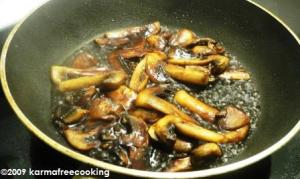
  1.  In a large skillet over medium high heat, heat up the butter and oil.  When the butter/oil is very hot, add the sliced mushrooms.  Toss a bit so the mushrooms are coated with the oil mixture on most sides.  But don’t toss them continually; allow them to get brownish on one side for a few minutes before moving them again.  Add the thyme.
  2. After about 10 minutes of cooking, the mushrooms will have shrunk in size and are golden brown.  Now, add the salt and pepper and toss to combine.
  3. After another minute, add the balsamic vinegar.  Be careful because it splatters a bit and the pungency of the smell can “hit you in the face”.  Toss the mushrooms to combine and allow the balsamic to be absorbed by the mushrooms and evaporated a bit from the heat of the pan.
  4. Turn off the stove and allow continuing to cook with the residual heat that’s there.


I thoroughly enjoy these with peppered goat cheese balls on whole wheat crackers.  It’s serves as a great appetizer for a small get-together dinner party or to serve at a night of wine and cheese.

Pasteles in Banana Leaves

23 Dec

This is a very labor-intensive dish… the very same reason why most people in Puerto Rico buy their “pasteles” from someone who has the experience and the patience to make these.  In our yoga center, Mai, Mili and Katy are the pasteles experts.  They even make them to sell to anyone who’s interested in a delicious vegetarian version.

Pasteles hold the essence of the Puerto Rican holiday dinner…  a Xmas season without pasteles is like a day without sunshine, a beach without sand…  you have not eaten true Puerto Rican holiday food until you have one of these.

The whole deal is this MASA made from green banana and yautía filled with a soy-based stew.   Then it’s all wrapped in a banana leaf that will actually give the masa some of its flavor.  It’s very characteristic and you can find banana leaves in the refrigerated or produce section of a Latin supermarket.   Pasteles without at least a piece of banana leaf miss something.


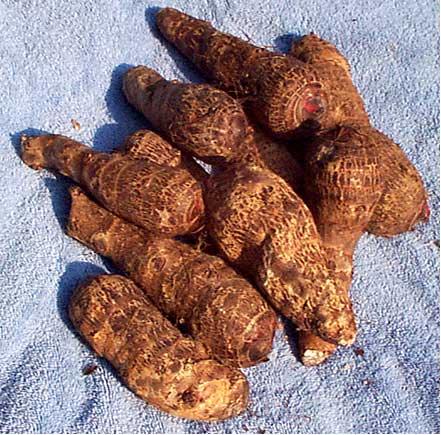
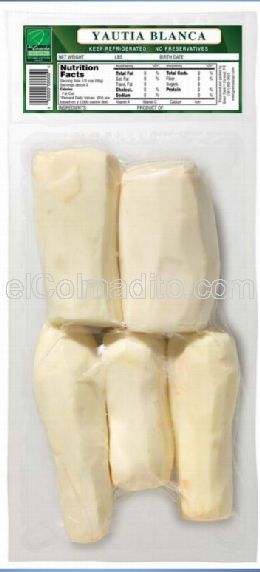
This is a yautía… in Cuba, yautías are called malangas.  However, in Puerto Rico we call malanga a completely different tuber.  Do not confuse them.  I looked up in the internet and apparently it may also be called tanier = tannier = tannia.  Don’t know where, but if you can’t find them by the yautía name, any of other those might also work.  Yautías come in two varieties – white and purple.  You will need yautía blanca or white yautía for this dish.


PASTELES IN BANANA LEAVES

12 green bananas
1lb white yautía
¾ cups milk
1 ½ tsp salt
2tbs sofrito
2 tbs annatto oil
Filling:
½ cup textured soy protein – in cubes, soaked in filtered water for about ½ hour
1 small potato, cubed small
1 cup cooked chickpeas or garbanzo beans
2 cups mixed vegetables
½ cup raisins (optional)
½ cup sliced Spanish stuffed olives
3 tbs sofrito
2 tbs tomato paste
2 cups water
1 tbs olive oil
 
20-25 pieces of paper to roll pastels
Banana leaves – cut into rectangles of 10” x 8” approximately
Cotton kitchen twine


  1. Peel the banana and yautía and shred them using a food processor or a machine called Champion.  I have seen this machine also be used at Iron Chef America competition.
  2. Add the sofrito, salt, annatto oil and milk to the banana and yautía mixture.  Mix it all well to create a homogenous smooth mixture.  The annatto oil will provide a bright yellowy/orangey color to the mixture.  Set aside.

Now we make the filling…

  1. In a large saucepan, cook the olive oil along with salt, sofrito and tomato paste.    Add the garbanzo beans, soy protein, potato and water and cook everything for about 15-20 minutes. 
  2. Add the mixed vegetables and the raisins, if using.  Cook everything for about 15 more minutes.  Once everything is cooked, add the olives.

Now we assemble the pasteles…

  1. Place a banana leaf on top of the pastel paper (it’s similar to butcher’s paper). 
  2. Take a little bit of the sauce of the soy mixture and wet the banana leaf. 
  3. Take a large cooking spoon and spoon about a spoonful of masa in the center of the banana leaf.  Using the spoon, form a well in the center of the mixture and place about 2 tablespoons of the soy/vegetable mixture in the well. Carefully fold the leaf over, in order to cover the filling with masa on all sides. DO NOT over stuff them.
  4. Fold the paper like a letter and fold in the sides to create a compact package.  Tie them with cooking twine.  Be careful not to tie too tightly.
  5. Repeat this procedure until all the masa mixture has been used. You can now freeze or cook them when you are ready.  

When you are… 

  1. Place a large pot of salted water (as if you were to prepare pasta).  Boil the pasteles for about 45 minutes until the masa is cooked.  If you froze them, place them directly from the freezer onto the boiling water and boil for about 1 hour.
  2. Drain them well when you take them out of the water…  it’s not nice to have a puddle of pastel water in your plate when serving yourself the rest of the Xmas dinner.  Many people, including me, enjoy pasteles with a drizzle of ketchup on top.