Tag Archives: brown sugar

Organic Unrefined and Unbleached Sugar

11 Feb

I keep hearing on the Food Network that the brown sugar available in the US is indeed refined white sugar mixed in with molasses. That statement gave me the creeps. I keep urging you to use brown sugar instead of refined white sugar and the product I am recommending is not as good as I thought it is.

The brown sugar that sells in Puerto Rico comes mostly from the Dominican Republic where, according to my limited research, is indeed less refined sugar to which the molasses were never taken out to begin with. But that may not be the case with other regular commercial brown sugars available in the US.

This is why I have moved myself to buy sugars that are indeed less refined than the commercials brown sugars you find yet they are still available in your regular supermarket or health food store. For the last few years, I am buying at home mostly turbinado or muscovado or organic brown sugars. But my new love is Rapadura Unbleached and Unrefined Sugar.

organic_whole_cane_sugar

I had bought this sugar a few years ago… I kept it in my fridge because it’s so dark that it kept darkening every smoothie or dish I used it in. I have not gotten used to its taste. It tastes more toasty and caramel –ly than your regular average brown sugar. At the end of last year I was in a mission to stop buying stuff I already have at home… and one of these things was sugar. I use it mostly to sweeten a bit my morning smoothies or my hot cereals; most rarely to make desserts.

I fell in love with this sugar the second time around… it’s certainly more expensive, but you use much less quantity than you would use regular white or even brown sugar. The bag lasted me for a couple of months at least using it almost daily in my breakfast smoothies.

image_thumb4

My recommendation to you is to search in your supermarket and purchase the sugar product that is as natural and less refined as possible within your budget. It’s hard to understand why something that’s as natural and the least processed costs more in our neck of the woods, but remember, what we don’t spend in good food and nutrition on the front end… we’ll eventually need to find the funds to take care of illnesses in the future. I am putting my money on the front end and trying to eat as natural and healthily as my budget allow me to.

Pear and Blackberry Crumble

9 Nov

My nephew likes pears… but these pears at my sister’s house were DRY!!!! Dry, dry, dry… and tasteless. So I decided to make a dessert out of it. I can’t stand to waste food… and organic at that.

I forgot to take a picture of the final product… but the results were pretty different from the original raw fruit. The filling for this crumble came out juicy and sweet and a bit tangy with the addition of the lime juice. That tang balances the sweetness in the fruit and the sugar.

If the pears would’ve been juicy to begin with, maybe you can delete the extra juice. But I just wanted to show you how you can transform a not so delicious fruit into a delectable dessert.

PEAR AND BLACKBERRY CRUMBLE

2 pears, peeled and cut into small pieces
10 blackberries
The juice of 1 lime, you can add some zest if you want too
2 tbs orange or apple juice, especially if the pears are a bit dry… like mine were
2 tbs of organic or brown sugar for the fruits, plus 3 additional heaping tbs for the topping
Pinch of salt
1 heaping tbs cornstarch
2 heaping tbs of spelt flour
2 heaping tbs of butter ( I used softened butter)
1 packet of organic instant maple oatmeal
A handful of walnuts


Does it show that when I was making the recipe I only had a soup spoon available??? So it’s all measured by the spoonful…

  1. Pre-heat oven at 350F.
  2. Just place the fruit in a medium pyrex glass baking dish. Add the apple or orange juice. Sprinkle on top the sugar, cornstarch, lime zest, lime juice and the pinch of salt. Mix well together.
  3. On a separate bowl, mix together the flour, oatmeal, sugar, walnuts and butter. Using a fork, mash the butter into the flour/oatmeal mixture. It’ll become like the texture of wet sand. When it feels like that, add it on top of the cut fruits.
  4. Bake for about 30 minutes, until you see the juices of the fruit bubbling and the top is golden brown.


I always leave in the oven until we’re about to eat. I like it warm… with a scoop of ice cream on the side.


Candied Papaya in Syrup

31 Jul

Dulce de Lechoza, Dulce de Papaya or Candied Papaya Syrup, however you prefer to call it, is a very typical Puerto Rican dessert.

When I used to belong to Mili’s cooking team at the Yoga Center, I needed to come up with different desserts for our menus all the times, because if not, Mili would resort to her trusted papaya dessert each and every time.

It got to a point that I kinda shunned dulce de papaya because I was so fed up with it… but now that Mili doesn’t make it so often, I miss it. I asked her for the recipe… because I wanted to learn how to make it.

I want to thank Jesiel, my long-time friend and author of Sweet Journey of Inspiration, for so graciously lending me the use of her photo of her dulce de papaya.  Jesiel is a former advertising professional and currently is a pastry chef working as a food stylist in Paris, France. We met working together, and even though our professional paths have somewhat diverted, we always stay in touch and connected in more ways than you’ll ever think.

Jesiel’s recipe and Mili’s recipe were very similar indeed. The biggest difference is that Mili’s recipe she stopped using baking soda because we were informed it is not that good for you to cook with it. I will get more info on the WHY for you guys soon… promise.

In the meantime, enjoy the flavors of Puerto Rico…


Photo courtesy of Sweet Journey of Inspiration

CANDIED PAPAYA IN SYRUP

 1 large green papaya, but that’s showing signs that it’ll start ripening soon
2 cinnamon sticks
½ tbs whole cloves
2 cups brown sugar
1 tbs vanilla powder
Water


  1. Cut papaya in half and clean the inside from all membranes and seeds.
  2. Slice it thinly, in about ¼ inch think and about 2 inches wide. Place in a large bowl. Cover the papaya slices with filtered water and let it rest for about 2 hours.
  3. After the 2 hours have passed, drain the papayas and place in a large pot. Add the cinnamon sticks, cloves, sugar, vanilla and about ¼ cup of water. Cook over medium heat for about 45 minutes, stirring occasionally. If the syrup is boiling too aggressively, turn down the heat. You sure do not want that hot sugar to boil over. Experience is speaking to you here…
  4. Remove from the heat and let it rest until room temperature. Chill in the refrigerator in a sealed container.


This candied papaya in syrup is best eaten cold and with a nice slice of cheddar cheese or queso del país.

Mango Ginger Granita

4 Jul

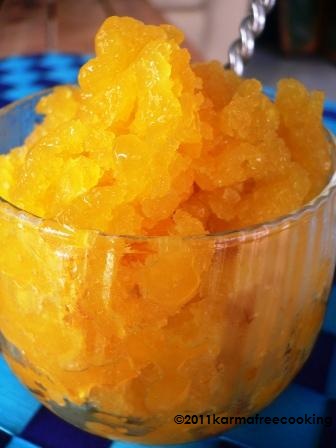
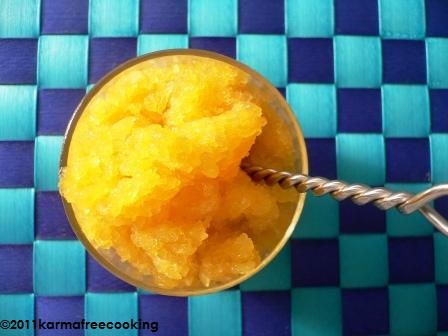
Another one of the desserts we attempted  to serve at the Italian Dinner at the Yoga Center recently was a Granita…

 The granita name might transport you to Italy, but we have our own versions all the same.   In Puerto Rico we grew up eating “limbers” and “piraguas”. Limbers are basically sweetened and frozen juice and you eat it directly from the small plastic cup in which you freeze it in. Piraguas on the other hand is the traditional shaved ice with flavored syrup on top served on a paper or plastic cone. In essence, granitas are a hybrid of these two local Puerto Rican treats.

I use the help of my trusty food processor to help with the shaving… I am just too anxious to shave the ice by hand. Technology exists for a purpose… let’s take full advantage of it, no??


MANGO GINGER GRANITA

3 cups mango nectar
1 cup water
½ cup raw turbinado or brown sugar
3-inch piece of fresh ginger, sliced
  1. We make the ginger simple syrup first… just bring the water, ginger pieces and sugar to a boil in a saucepan until the sugar dissolves completely. Let the ginger steep in the simple syrup while the liquid cools off.
  2. When the simple syrup has come to room temperature, strain the ginger pieces. Mix together the ginger simple syrup and the mango nectar in a glass 9 x 11 container.
  3. Place in the freezer for about 6-8 hours for it to fully harden.
  4. When you’re ready to serve, remove the frozen mango juice mixture from freezer and using a sharp tool, pry it away from the mold and break it off into pieces you can fit into your food processor. Pulse a few times and process until you have a slushy.

Serve in individual cups and enjoy.

If you’d like a more pronounced ginger flavor, I suggest you peel the ginger before steeping it in the simple syrup and do not strain the ginger pieces before mixing in the mango nectar. This way, you can process the frozen ginger pieces together with the rest of the frozen juice and you’ll get a very interesting prominent ginger flavor.


Sesame Seed Horchata

21 Mar

Last summer there was a conversation on Serious Eats about non-alcoholic drinks and how easy it is to make horchatas… and most people are familiar with the Mexican version of horchatas made from rice and cinnamon. However in Puerto Rico, horchatas are made from sesame seeds or as we call them in Spanish, ajonjolí.

I was not aware a horchata made from sesame seeds was so unique until Serious Eats editor, Adam Kuban, flagged my comment that week as something interesting on the SE Talk threads.

Sesame Seed Horchata is served a lot in our Yoga Center mostly because it’s a beverage that’s easy and economical to make. And the fact that it’s a great source of calcium and nutrition is an added plus.

It’s been awhile since I’ve made horchata at home. It’s not really difficult to make – hey, it only has 3 ingredients. But I do agree it’s a bit tedious and can be messy if you’re not organized. I made it with my new Magic Bullet, but you can certainly make this just the same in a blender.

This recipe makes about 96 ounces of horchata… but I have never ever measured the exact amount of water I use. This is something I have always “eye-balled”. But do not be intimidated by the lack of measurements… horchata is so forgiving that you’ll not mess it up. Here we go…


SESAME SEED HORCHATA

1 ½ cup sesame seeds – soaked in 3 cups water
1 cup brown sugar
Water


Start by soaking the sesame seeds in some filtered water. I like to soak the seeds for about 1 hour. This is certainly not necessary, but I think it helps extract more flavor and creaminess from the seeds. I soak in about 3 cups of water, just to give you an idea of the amount I use. Do not soak for too long (longer than 8-10 hours) because the water and seeds may start to ferment and will give you a weird aftertaste.

Sesame seeds just starting to soak...

After aboout 2-3 hours of soaking... See how much they plump?

  1. Gather all your equipment – a large pot with a fine sieve, a bowl to collect the sesame seeds after they’ve been blended once.  I also like to have the container where I’ll store the horchata with a funnel on hand.
  2. Drain all the water from the soaking seeds.
  3. Place some of the sesame seeds in the large container of your Magic Bullet or blender. Fill almost to the top with filtered water. Process for a few minutes in 30 second intervals to puree the seeds as much as possible.
  4. Drain the milky sesame seed pureed water over the sieve. Use a large spoon to move the slush around, but you don’t need to press extremely hard to release all the liquid. If you do, you’ll only push a lot of sediment into the finished horchata that will not be very palatable in the end. So there’s no need to use extra muscle for this. Allow gravity and a slight firm hand to do its job.
  5. Save the leftover seed slush in a bowl for re-processing. Repeat with all the never-processed seeds in the same way as before. I usually divide the original seeds into 4 batches because the Magic Bullet large container is not as big as a regular blender. If using a regular blender, I might divide into only 3 batches because you can accommodate more water too. After processing all the seeds once, reprocess in the exact same way, diving it into batches, but this time after passing it through the sieve, just discard the leftover seeds.
  6. Add the sugar with some additional water to the blender and process to break up the sugar and make it easier to dissolve in the horchata. Add the processed sugar water to the horchata. I usually get about 96 ounces of total liquid.
  7. Mix well all-together. Chill before serving.

The horchata will separate when standing in the fridge… but just mix well before serving.

This is an excellent source of calcium and is great to drink by itself, in oatmeals, other hot cereals and smoothies.