Archive | 2008

Stewed Chayotes

23 Dec

When the weather turns a little bit chillier – to us in Puerto Rico that means when the weather goes from the 90’s to the 78’s… sometimes what your body craves is something stewy, something warm to warm up your body and soul.

I have mentioned to you before about my Stewed Potatoes… well, I make it also with Chayotes.  Chayotes are a vegetable that eats like a potato.  You make it very similar, but the taste is more watery.  I already showed you how to make Stuffed Chayotes.

Well, this time around we’ll make it for you in a stewed version.  My aunt was feeling down after surviving stomach flu.  She did not have appetite at all.  So I offered to make her rice and something stewed, something with lots of sauce to wet the rice and give her some sustenance.   It’s very easy to make… even when you’re sick you can make a small pot of this…
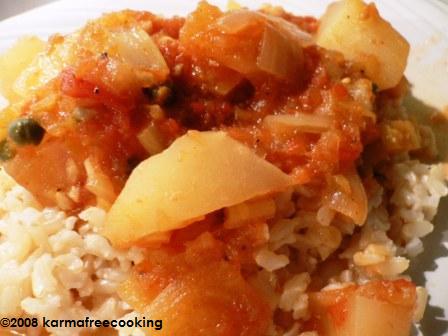
 chayotes-guisados

STEWED CHAYOTES

1 medium chayote, peeled and cut into 1″ cubes
1 medium onion, sliced
1 tbs olive oil
1 tbs sofrito
½ of a vegetable bouillon cube
1 12 oz jar of stewed tomatoes
1 tbs tomato paste
1 laurel/bay leaf
 8-10 olives with pimentos
1 roasted red bell pepper, sliced
1 tbs capers
Salt and Pepper to taste
1 tbs apple cider vinegar or white wine vinegar
½ cup to ¾ cup of water
  1. In a medium sauce pan, add the olive oil and heat over medium heat.  Add the sofrito and vegetable bouillon cube.  Smash the cube a bit so it dissolves well.  Add the onions and sauté until soften.  
  2. Add the chayote pieces and stir to combine.   Add the stewed tomatoes, tomato paste, apple cider vinegar, water, salt and pepper.  Stir well to combine.  Add the bay leaf, the olives, red bell pepper and capers.  Cover and bring to a boil.  Simmer for 25-30 minutes. 
  3. Make sure the chayotes are fork-tender.  When they are, I usually turn it off and let it finish cooking with the residual heat from the stove.

Serve over brown whole-grain rice.

A night of French Cheeses

22 Dec

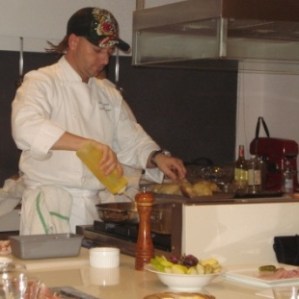
One of the presents I gave myself for my birthday was a Cheese Class given by our favorite French chef, David Chamyol, from the restaurant Bistrot de Paris in San Juan. My friends, Laura and Annie Mariel accompanied me for a whole night of dishes made primarily with French cheeses.

               cheese-class-nosotras-copy         notre-chef-de-cuisine-copy

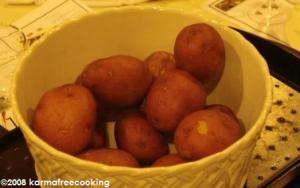
It was very fun. First, we learned how to make raclette. Raclette is the cheese as well as the grill/broiler used to melt the cheese. It’s basically a melted cheese under a very special grill, also known as raclette, and then you pour the melted cheese on top of boiled potatoes, bread or vegetables. We tasted the cheese before melting and after… I was super surprised how different the cheese tastes after its melted. The taste is very pungent and sharp when you cut it fresh, but after its melted the taste turns very mellow. I loved it on top of the boiled potatoes… a great nibbling dish for a night with friends.

             raclette-en-bandejita-copy      raclette-en-proceso-de-derretirse-copy


              papas-sobre-raclette-copy         raclette-sobre-papas-copy
Actually, my friend Laura loved so much the raclette concept, she went online the next day and immediately bought herself a raclette grill. Apparently, at our Fete des Francophones in January, the raclette will be making a special appearance.
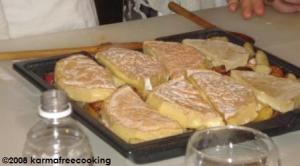
Then, we learned how to make Tartiflette… this is a baked dish made also with potatoes and onions sautéed in butter and olive oil. Then, you transfer these potatoes to a baking dish and cover with pieces of Reblochon cheese. Then you bake the tartiflette in the oven for 20 minutes and voila, you’ve got a very hearty dish that you can enjoy with a nice side green salad. The cheese is very smelly and pungent. This was my least favorite dish to be truly honest – maybe because I was getting full with the boiled potatoes and raclette… it is very rich and dense.

            tartiflette-antes-del-horno-copy          tartiflette-con-ensalada-copy
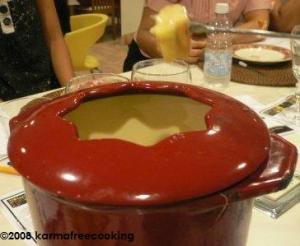
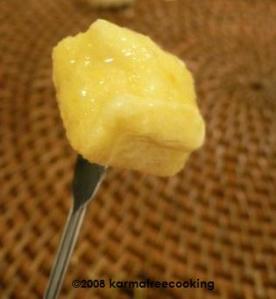
To finish, we learned how to make a proper French cheese fondue. You shred equal parts of gruyère, comté and beaufort cheeses and add ½ part of vacherin cheese. You add those to a base of white wine, Dijon mustard, nutmeg, salt and pepper. If you truly want to make this karma-free, I would make it at home with a bit of apple cider, apple juice or white grape juice or even apple cider vinegar. You melt the cheeses in that base and add a bit of kirsch. I was told that a proper fondue was not a fondue without the kirsch. I’ll have to find a reasonable facsimile to emulate the cherry flavor without the alcohol. But it was lovely… I loved dunking the pieces of bread, cornishons, pear and apple in the smooth cheese blend. To be honest, this was my first time eating a cheese fondue. I’ve seen it made plenty of times at the Food Network, but never tried it myself. We all fell in love with the concept and decided we needed to repeat it for one of our Les Francophones get-togethers.

              quesos-fondue-copy            fondue-copy

                                                                                pan-con-fundue-copy
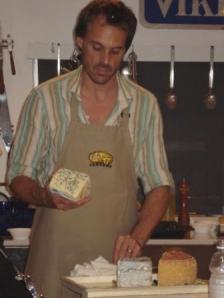
I should also mention that in addition to the cheeses used in the dishes I have described above, we also tasted goat cheeses, cheeses made from brebis mountain sheep, blue cheeses, among others. These cheeses were specially provided by Marco Dettling from The Cheese Market, a Swiss guy now living in Puerto Rico and imports many fresh European cheeses. His appreciation and knowledge of European cheeses was evident. He actually turned out to be an “almost neighbor” of mine. We live in the same street… what a small world this is, no?

cheese-master-blue-cheeses-copy

What I loved about this cheesy experience was that there’s so much versatility when cooking with cheese… pastas or risottos is just a small fraction of what you can do. French cuisine is filled with creamy and cheesy concoctions that will give you the opportunity to savor new and interesting kinds of cheeses you might not be usually accustomed to taste. It’s a window into another culture and exposes you to new tastes and experiences.

I’m still here…

21 Dec

I feel bad… I feel as if I have sort of abandoned you.  I took Thanksgiving week off as a little vacation, and afterwards, I got the most horrible flu possible.   I was in bed sick for 2 full weeks… no energy or desire to cook, write or do anything than just lie in bed sick.  I had fever every night and constantly felt shivers.

I tried many natural remedies – lemon, honey, aloe and onion to aid my strong coughs, medicinal teas, homeopathic syrups, drinking lots of liquids, etc.  I ultimately had to resort to traditional antibiotics and remedies. The moral of this story is that you should always try first natural remedies to feel better when you’re sick, but you should also be cautious and if your illness has gotten a hold on you that natural remedies can’t help much anymore, we need to have the wisdom and fortitude to resort to traditional remedies and later on then do some fasting and eat lots of raw foods to counter acts any negative side effects of those traditional prescription drugs.

KarmaFree Cooking promotes a more natural and vegetarian lifestyle, but it’s better to “pollute” your body with some traditional drugs than to have a super clean system, but then be “6-feet under” because an illness was not properly taken care of.  My natural doctor believes in that and I believe in him.

I am much better now and ready to roll with you…

And on a separate note… while I was “under the weather”, my friend Fiona from Recipes2Share gave me an Award – the Superior Scribbler Award.  I really do not know the criteria used to give the award to someone, but nonetheless I feel very honored and privileged.   So, I have set up my own criteria…

superir20scribbleraward2

I reciprocate to Fiona… by forwarding this award to:

  • Kathleen at Kathleen’s Vegetarian Kitchen – my friend and who gave me the initial push to start this KarmaFree project
  • Michael at Herbivoracious – who was brave enough to leave his 9-to-5 job and try vegetarian cooking as a career for a while
  • Heidi at 101 Cookbooks – who’s a continuous source of inspiration
  • Brenda at Bren’s FlaNboyanteats – a Cuban friend who’s taking the Latin cuisine to Emeril’s and beyond
  • My friends at Serious Eats – where I have found food junkies just like me where we can express ourselves without limitations


The rules of the award are simple to carry on:

  • Post the award on your blog
  • Link to me for giving it to you
  • Link the  originating post here
  • Pass it on to five deserving people
  • Post these rules for your recipients

Mushroom and Goat Cheese Spread

24 Nov

I am taking these conversational French classes with my friends… we get together to speak French every week.  We talk about our stuff, all in French.  But we’re disciplined too – we discuss and review grammar, we give ourselves homework and even assign Show and Tell projects.

Our first Show and Tell presentation was about the food of a certain region of France.  I selected the Loire Valley and the Center of France.  I was not sure what I was going to find there, but I was determined to make my presentation vegetarian-friendly.  We had to add a TASTE to the Show and Tell, making it a Show, Tell and Taste…

             pays-de-la-loire-map        pays_de_la_loire_accommodation

To my surprise, the Loire Valley is also affectively known as the Garden of France, because of its proliferation of fruits and veggies – apples, pears, plums, mushrooms – porcini, chanterelles, among many other wild varieties. 

          reine-de-les-reinettes       chanterelles

The Loire Valley is also the heart of goat cheese production in France.  So for my TASTE portion of the presentation, I decided to make this spread as an appetizer, using traditional ingredients from the Loire Valley…


 mushroom-and-goat-cheese-spread2

MUSHROOM AND GOAT CHEESE SPREAD

2 tbs butter
1 small shallot, chopped
1 garlic clove, chopped
½ pound of button mushrooms, coarsely chopped
4 ounces of goat cheese
2 ounces of cream cheese
1 tbs plain yogurt
2 tbs extra-virgin olive oil
Salt and Freshly-cracked Pepper to taste
1 whole-wheat baguette, sliced on the bias


  1. In a medium saucepan, melt butter.  Add shallot and garlic and sautee for about 1 minute.  Add the chopped mushrooms.  Cook until the mushrooms begin to soften, about 5-6 minutes.
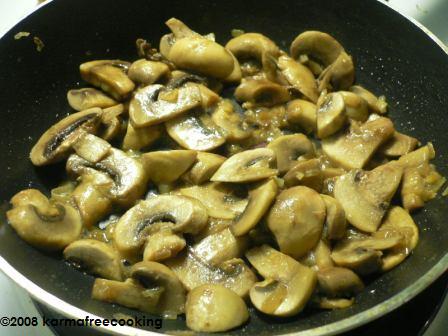
  2. sauteed-mushrooms1
  3. In the bowl of a food processor, add the goat cheese, cream cheese, yogurt and cooked mushrooms.  Add the oil, salt and pepper.  Pulse a few times to combine. 
  4. Toast baguette slices.   Serve spread with baguette toasts at room temperature.


The French taste is truly authentic.  I also ate this spread mixed with boiled potatoes.  It’s delicious and versatile.

Broccoli Stalks

22 Nov

When you cook broccoli… what do you do with the stems???

I used to be the one who would cut the florets off and I would get rid of the stalk.  But when I started cooking weekly at the Yoga center, the first time I attempted to throw away the stalk, I got a lesson on how to utilize all the resources available in the kitchen, and that includes the broccoli stalks.

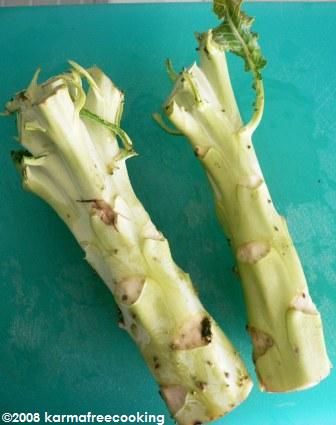
broccoli-stalks

But you just can’t go and cook them the same way as the florets… the florets are delicate and with just steaming they’re perfectly cooked, as I mentioned to you previously here.  But the stalks are tougher and need to be treated differently.

First, cut off the end of the stalk.  You’ll see there is a green edge and a more whitish center.  We need to peel off the greenish outer part.  It’s stringy and not palatable at all.  What I do is to pierce with a knife just inside the green part and pull off the green part.  Just like with an asparagus, the green part will peel away where it’s supposed to cut off if you make the cut as deep as needed.  After you’ve peeled the whole stalk, just cut in into small pieces.


broccoli-stalk-2        broccoli-stalk-3

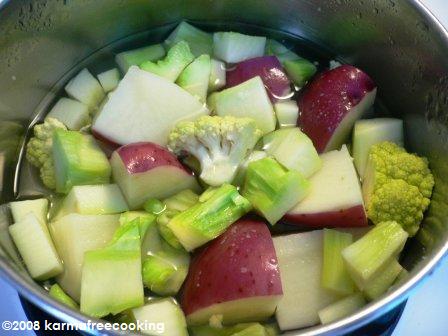
Now there are several things you can try out… one option is to boil the stalks together with some potatoes.  After they’re cooked, you can smash them together with the potatoes and you’ll be adding lots of added nutrition to the potatoes.  Because I use little water to partly boil/partly steam the potatoes/stalks, I usually use part of the water left over to mash the potatoes/stalks.  The water has nutrition of the veggies you’re cooking.

boiling-broccoli-w-potatoes

If you’re stir-frying, you can add the stalks at the beginning of the stir-fry, with other harder to cook veggies, like carrots.  By the time the stir fry is done, the stalks will be fully cooked.

The next time you buy broccoli, plan to use the stalks as well as the florets.  You’ll be amazed at how versatile and delicious they are.  It’s another way to stretch your dollar in these tough economic times.