Archive | Puerto Rican delicacies RSS feed for this section

A new twist on MayoKetchup – Wichi’s Version

4 Jan

My brother-in-law made a huge batch of sorullitos de maiz for New Year’s… I had the chance to have some and they were awesome.  But I noticed he made his MayoKetchup different from mine…

Here’s his version – super tasty, really nice twist on the traditional recipe.

 mayo-ketchup-part-21

MAYOKETCHUP – WICHI’S VERSION

¼ cup egg-free mayonnaise, like Vegenaise
2 tbs ketchup
1tsp yellow mustard, I am sure you can substitute with Dijon or even grain mustard
A dash of crushed garlic – Wichi mashes his garlic in a “pilón”, but you can use the one in a jar
A pinch of salt


  1. Mix everything together in a small bowl. 

Serve with a nice side of sorullitos de maiz.

Stewed Chayotes

23 Dec

When the weather turns a little bit chillier – to us in Puerto Rico that means when the weather goes from the 90’s to the 78’s… sometimes what your body craves is something stewy, something warm to warm up your body and soul.

I have mentioned to you before about my Stewed Potatoes… well, I make it also with Chayotes.  Chayotes are a vegetable that eats like a potato.  You make it very similar, but the taste is more watery.  I already showed you how to make Stuffed Chayotes.

Well, this time around we’ll make it for you in a stewed version.  My aunt was feeling down after surviving stomach flu.  She did not have appetite at all.  So I offered to make her rice and something stewed, something with lots of sauce to wet the rice and give her some sustenance.   It’s very easy to make… even when you’re sick you can make a small pot of this…

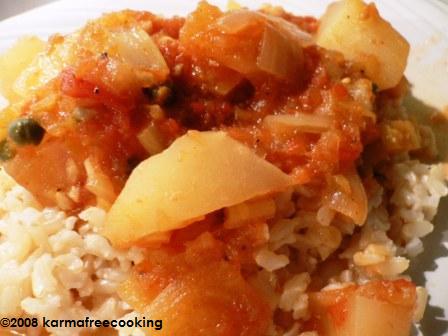
 chayotes-guisados

STEWED CHAYOTES

1 medium chayote, peeled and cut into 1″ cubes
1 medium onion, sliced
1 tbs olive oil
1 tbs sofrito
½ of a vegetable bouillon cube
1 12 oz jar of stewed tomatoes
1 tbs tomato paste
1 laurel/bay leaf
 8-10 olives with pimentos
1 roasted red bell pepper, sliced
1 tbs capers
Salt and Pepper to taste
1 tbs apple cider vinegar or white wine vinegar
½ cup to ¾ cup of water
  1. In a medium sauce pan, add the olive oil and heat over medium heat.  Add the sofrito and vegetable bouillon cube.  Smash the cube a bit so it dissolves well.  Add the onions and sauté until soften.  
  2. Add the chayote pieces and stir to combine.   Add the stewed tomatoes, tomato paste, apple cider vinegar, water, salt and pepper.  Stir well to combine.  Add the bay leaf, the olives, red bell pepper and capers.  Cover and bring to a boil.  Simmer for 25-30 minutes. 
  3. Make sure the chayotes are fork-tender.  When they are, I usually turn it off and let it finish cooking with the residual heat from the stove.

Serve over brown whole-grain rice.

Veggie Sancocho

19 Nov

Today we celebrate the Discovery of Puerto Rico…  or the day Christopher Columbus landed on the Island of Puerto Rico for the first time in 1493.  Because if you ask the Taínos who already lived on the Island, they already knew Boriquén existed and they needed no discovery of any kind.

I wanted to commemorate this day with a very Puerto Rican dish – SANCOCHO.  The name is not that pretty, but it tastes awesome.  It’s a stew/soup of many root vegetables, or as we call them locally, viandas.  It’s great for those rainy days in November…  as we thankfully say goodbye to the hurricane season, which fortunately has left Puerto Rico unscathed this year.

I’ll be honest, when I make this dish, I’ve made it for 40 people at a time… so bear with me when I try to scale the measurements for something more in tune with a regular family of 4. 

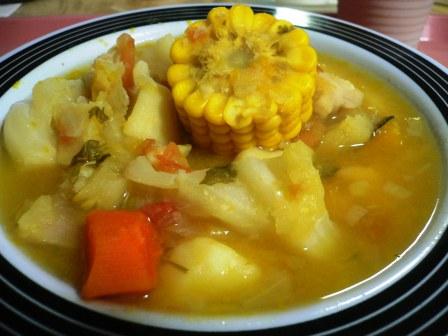
 sancocho

SANCOCHO

3 medium potatoes, can be russet, red skin, Yukon gold, cleaned and cubed
2 medium carrots, peeled and cut in ¼ inch rounds
1 medium yautía blanca, peeled and cubed
1 medium yautía lila, peeled and cubed
1 small malanga (taro root), peeled and cubed
2 celery stalks, cleaned and sliced thin
1 small onion, diced
1 small bell pepper, diced
1 corn on the cob
¼ head of white cabbage
2 tomatoes, peeled and cut in small dice
2 tbs sofrito
1 tbs olive oil
1 vegetable bouillon cube
2 bay leaves
½ bunch cilantro (optional), chopped
1 tsp Herbamare seasoning (optional)
1 tbs Salt, divided
10-15 turns of the mill of Freshly Cracked Ground Pepper, divided
Water
Avocado slices, for garnish at the end


  1. In the largest stock pot you have, start by adding the olive oil, sofrito, onion, bell pepper, celery and bouillon cube.  Smash the cube so that it melts in with the rest of the ingredients.  Allow for the celery, onions and peppers to soften.  Add the tomatoes and let those juices mix together. Season with a little salt and pepper.
  2. Add the viandas – potatoes, carrots, yautías, , malanga – and the cabbage.  Mix well with the ingredients already on the pot.  Add water until covering 1 inch over the contents of the pot.  Add the bay leaves, the chopped cilantro leaves, the Herbamare seasoning, some additional salt and pepper.  Taste to check the water is well seasoned. Cover.  Let it come to a boil and simmer at medium heat for about 30-40 minutes.
  3. Check the pot every so often and move the sancocho around, to avoid the bottom from scorching.  When you reach the 20 minute mark, add the pieces of corn on the cob.  Cover again and let it boil for the last 10 – 20 minutes.  Make sure the root vegetables are fork tender.
  4. Turn off the stove and let the sancocho finish cooking with the residual heat from the pot and stove.  Allow it to rest and mellow for about 20 minutes.  The soup will maintain hot for about 1 hour, no problem.
  5. When you’re ready to eat, garnish on top with slices of avocado… and if you want, you can drizzle a squirt of lime juice too.


This is a stew perfect for cold and rain days.  This is what we almost always eat after a few days of fasting at a Yoga Retreat.  It’s full of vitamins and nutrition and will even “revive the dead”.  There is a lot of ingredients, but it’s all chop and dump…  not that difficult.   

You can eat it with plain whole-grain rice…

Baked Plantains in their Skin

29 Oct

Have you ever made baked plantains???  It’s the easiest thing to do when you’re hungry and in a hurry…   My grandma used to tell me that a baked plantain and a glass of milk on the side were a full meal. 

You can make this one of two ways: 

1- On the microwave – I do not usually use the microwave for cooking because of all the radiation it emits onto the food, but I do use it on occasion when I am super duper hungry and there’s no time to wait…

2- On the toaster oven – because it’s sacrilegious, with our current electricity costs, to turn on a whole oven for one lonely plantain

This is not even a recipe… because the plantain is the ONLY ingredient… but this is important, the plantain NEEDS to be super ripe, almost black for this to work…


BAKED PLANTAIN in its SKIN

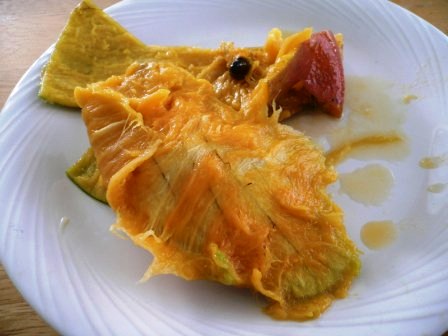
1 very ripe plantain


  1. Cut both ends of the plantain and make a slit on the plantain skin from top to bottom.

If doing this in the microwave oven…

  1. Place plantain on a paper towel and microwave on HIGH for 3-4 minutes, depending on how large is your oven. 
  2. After time has elapsed, check the plantain for doneness.  If you want, you can turn the plantain on its other side and microwave again on HIGH for an extra 2-3 minutes. 
  3. Wait a few minutes for the radiation and heat to dissipate.  Take out of the plantain, remove it from its skin and enjoy.


If doing this on a regular toaster oven…

  1. Place the cut plantain on a oven proof dish at 350° F. 
  2. Let the plantain bake in its skin for about 20-25 minutes.  The sweet smell of the sugars in the plantain will let you know when it’s done. 
  3. Turn off the oven and let it finish cooking in the residual heat for about 10 minutes more.  Take the plantain out of its skin and enjoy.


This is a great side dish for… anything, in my opinion.  But if you dare try it with a glass of milk, let me know how it goes…  it’s awesome!!!

How to Peel and Eat a Mango

29 Aug

I’ve seen the chefs at the Food Network do it… I’ve seen contraptions at Williams-Sonoma to help people separate their flesh from the pit.  And still I do not understand why people are so confused or baffled about the way to peel a mango.

To peel and eat a mango raw, as a fruit, all you need is a nice serrated knife.  Huh…  maybe a napkin too, because if the mango is juicy and delicious I can bet that some juice will run down your arm and the sides of your mouth.  But besides that, no other implement needs to be used or dirtied to peel and eat a mango.


This is a photo of a mango from my godfather’s tree in Miami… isn’t it beautiful???  Whenever I go to Miami, my uncle Felo always makes us eat and bring with us on the plane a mangoes and a avocados.  Once, I had to buy a new suitcase so I could carry the small farmer’s market he wanted me to bring along.

Back to our mango peeling class… this method was taught to me by my Puerto Rican grandma, Marianita.  Funny thing, that she taught the grandkids and not her daughters, because when I told my mom about writing this post, she was in the dark as many of you may be now.  I am amazed that my mom had never seen me eat a mango like this… I think she needs some gingko biloba to jig her memory STAT!!!!


 PEELING AND EATING A MANGO

What we will do is to peel the mango skin so you will end up first with a peeled top 2/3 of mango, keeping the skin on the bottom 1/3 so you have something to hold on to. Then, you will turn the mango upside down, peel the remaining skin and use the pit to hold on to the remaining mango, kind of like a popsicle.

All you need to do is three cuts with a serrated knife. 

Take the mango in one hand upright.  The stem end facing towards you.

You’ll make one cut across the mango, towards the bottom third.  All the way around the mango, but only through the skin, no need to go any deeper. 


Now the next cut goes from the cut you already made going up from one side of the mango continuing in one single swoop all the way to the cut on the other side of the mango.  Now repeat in a cross like fashion.  You must have ended up with a mango that still has the skin on but with 4 sections of cut skin on top. 


Take one corner of the skin and pull it to peel.  The whole peel will remove leaving you with a nice edible mango with the bottom still with skin so you can hold on to it and not be slippery.


When you’re done eating that side of the mango, just turn it upside down.  Hold the pit in your hand and pull the rest of the peel to expose the remaining mango flesh.


Eat the remaining mango and discard the pit once you’re done.
 

Number of utensils you need dirty – 1

Number of cuts made to the mango – 3

Experience eating a sweet mango with your hands and having the juice dribble down your chin – priceless!!!